A Note to Juniors
Fowler, Beck and others have written much about this topic. I thank them for the basis upon which this is grounded.
Software engineering isn’t going anywhere. Code monkeys are another story though. The news cycle is scary, and LLMs predict the next token extraordinarily well. But that’s not the same as thinking. True AGI is a different breakthrough entirely. If it arrives any white collar profession could be relegated to a hobby, not just ours.
There is a big difference between vibe coding and augmented coding1. Those who learn how to work in the loop with an agent and leverage ‘the genie’ will be the problem solvers our businesses rely on in the future.
Learn what the agent needs to thrive, the context, the design, and make sure you’re choosing a sensible toolkit2. They thrive in an environment of less noise and more signal.
What’s working against you - Architectural knowledge takes time, it takes care, and it takes effort. There are those already saying it doesn’t matter anymore. The minds I trust say otherwise, if anything they’re doubling down that architecture will matter more than ever. I tend to agree.
Vibe projects start out with so much promise. Then they hit a certain size, the velocity slows and things start to break. Maybe nobody even knows how the thing actually works3. The agent starts contradicting itself, and suddenly you’re fighting the tool instead of building with it. Design stamina remains true4.
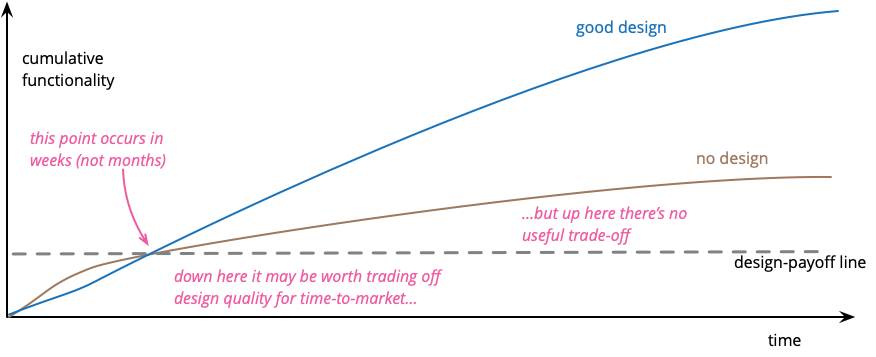
I’ve personally watched this play out. Where it inherits bad patterns, doubles down on them, digs itself deeper. That’s vibe coding and it’s exactly why intent still matters. It’s not just training data that matters either. It’s the harness5 we’re creating. The custom instructions, guardrails and design that we feed it. Tell it the architecture upfront, scope the task tightly, give it a failing test to aim at. That’s the difference between an agent that builds and one that wanders.
Use AI to accelerate your learning. Use it with intent. If you fail to do so you won’t be on the trajectory of ‘good design’ because you won’t know what it is. Therein lies the risk, and the people in the industry who will be replaceable. Don’t become a code monkey, that’s now the LLM’s job.
Not sure where to start? I’d recommend starting with Beck’s 4 design principles6
The good news - a lot of vibe coded projects are great ideas, and these fast prototypes could be an opportunity for many of us in the industry in the future. They’ll need to scale, they’ll need real architecture, and they’ll need people who know how to maintain the velocity. The genie and you are still the answer to that. There will always be jobs for the problem solvers in the industry, in fact they might just be more in demand than ever, will they still be called programmers? Probably. The role is changing, not being eliminated.
The businesses that win will be the ones that continue to invest in experts who know how to use the tools. Redundancies and layoffs will happen to the code monkeys, but that money will just as quickly be spent on the people with the knowledge of how to leverage augmented coding. They’ll have to, or they’ll be outpaced by their competitors.
Master augmented coding and you’ll outpace the seniors in the industry who refuse to. You have the advantage of being molded by these tools. You’re not catching up. You’re already there.